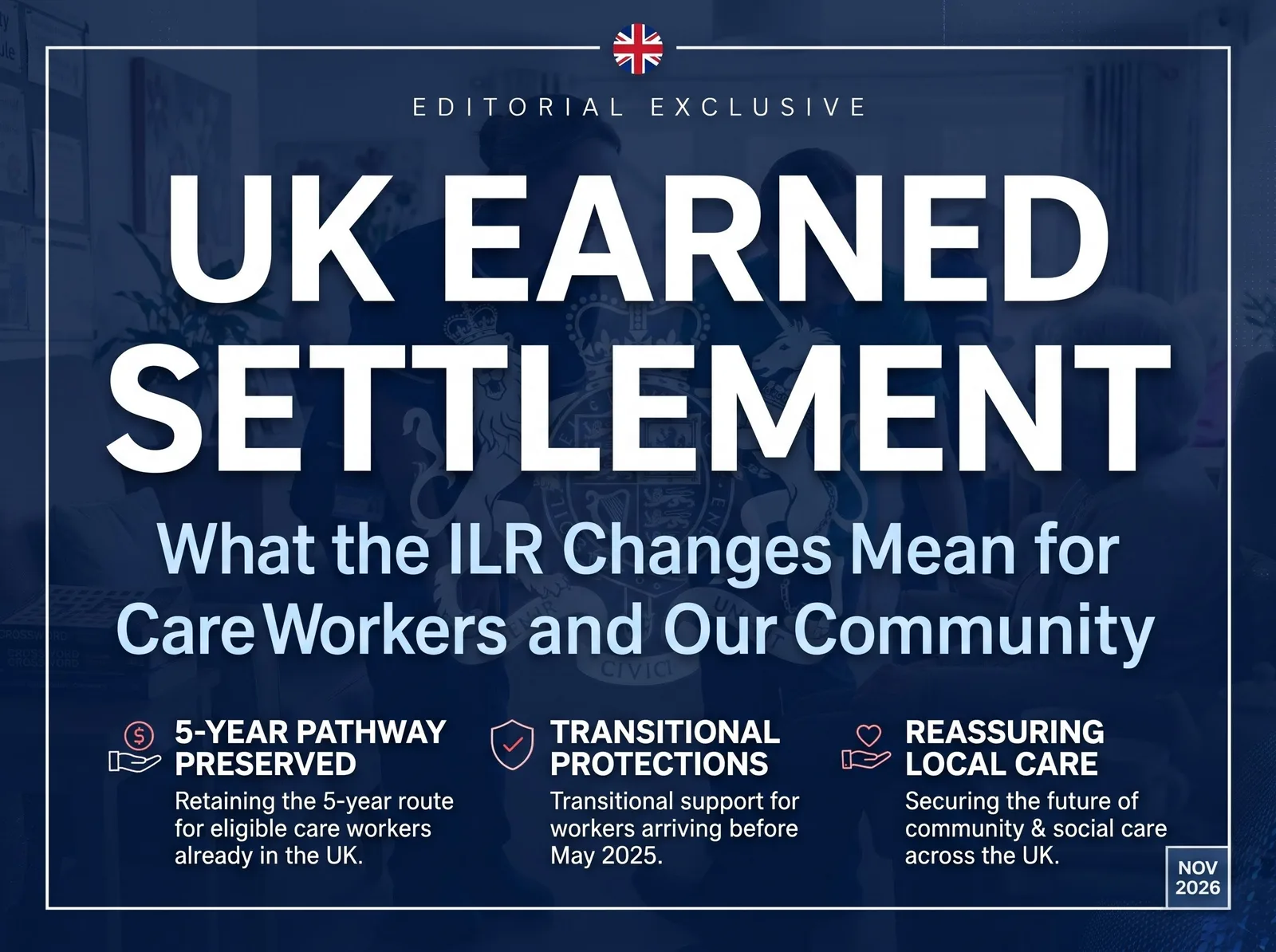
Home Secretary Shabana Mahmood presented the government's official response to the Earned Settlement consultation to Parliament on Monday 2 November 2026. The 62-page paper sets out the biggest overhaul of Indefinite Leave to Remain (ILR) rules in decades, moving the UK away from time-based settlement toward a system based on continuous economic contribution, language standards, and compliance with the law.
The public consultation received 204,667 responses, making it one of the largest exercises of its kind in British history. According to Home Office projections, more than 500,000 migrants currently in the UK will now wait longer to settle permanently than under the previous five-year baseline.
While settled British citizens are unaffected, the reforms directly impact over 500,000 migrants, sponsored skilled workers, healthcare professionals, and care staff across the UK. For visa holders living and working in Britain, these changes reshape the pathway to permanent settlement, extending qualifying periods and adding strict compliance hurdles.
Key takeaways for migrants and visa holders
- Care worker protection: Staff who entered or switched onto the Health and Care Worker visa before May 2025 keep their five-year route to settlement, provided they earn at least £25,000 and remain in genuine sponsored care work.
- Standard route moved to 10 years: Most standard work visa holders arriving after May 2025 will now need 10 years of continuous residence and qualifying earnings before applying for permanent settlement.
- Household income pooling on standard routes: Couples subject to the economic contribution test can combine earnings to meet the £25,142 household threshold (£12,571 x 2), protecting stay-at-home carers.
- Dependant partner timelines: Dependant partners on 5-year routes (such as NHS staff or higher earners) settle alongside the main applicant without separate earnings tests, provided they meet residence and mandatory personal checks.
- Zero tolerance on criminal records: Any adult criminal conviction, court fine, or conditional caution results in an automatic refusal of settlement.
- Long Residence route closed: The historic 10-year lawful residence route has ended. Time spent on student, graduate, or temporary visitor visas no longer builds toward settlement.
Care workers and transitional protections

The adult social care sector represents one of the largest employers of sponsored international workers in the UK. Care homes, residential facilities, and home care providers nationwide recruited heavily between 2022 and 2024 to address acute staffing shortages.
The government confirmed a specific transitional arrangement for these workers. Anyone who arrived or switched into the Health and Care Worker visa route before May 2025 will remain eligible for settlement after five years.
To qualify under this five-year route, care workers must meet the following criteria:
- Maintain a minimum annual salary of £25,000.
- Remain in continuous, genuine sponsored employment within the care sector.
- Satisfy all general mandatory checks, including English language and good character rules.
Care workers who fall short of the settlement requirements at the end of their five years will not face immediate departure. The Home Office has introduced a second chance provision granting a further five-year Health and Care visa. This extension is strictly restricted to employment within the care sector and carries no access to public funds.
For care staff affected by sponsor license revocations, extended grace periods will take effect on 1 February 2027. Under these new rules, affected workers receive 120 days to secure a new job offer with a licensed sponsor, followed by an additional 60 days to regularize their visa status. This 180-day window provides practical protection against rogue agencies and sudden job losses.
Care workers who entered the route after May 2025 will follow the standard 10-year settlement pathway.
The new settlement pathways
Under the Earned Settlement system, the qualifying time required before an applicant can apply for Indefinite Leave to Remain depends directly on tax contributions, public service roles, and immigration history:
- 3 Years (Exceptional contributors): Earnings of £125,141+ in 3 of the last 4 years; no access to public funds; approved talent visas.
- 5 Years (Higher earners & public service): Earnings of £50,271+ in 3 of last 5 years; eligible NHS & school staff (RQF Level 6+ such as doctors, registered nurses, and teachers); pre-May 2025 healthcare and education staff below RQF6 on national pay scales; British partners; or resettled refugees.
- 10 Years (Standard baseline): Default baseline route for Skilled Workers and post-May 2025 care staff; earnings of £12,571+ in 5 of previous 7 years.
- 20 Years (Breaches & state support): Applies to adult immigration violations, visa overstays, or accessing public funds within 5 years.
- 30 Years (Unauthorised arrivals): 10-year illegal entry penalty added to Core Protection baseline for unauthorised small boat arrivals.
Mandatory requirements for all applicants
Higher earnings or lengthy residence cannot bypass the mandatory criteria. Every applicant aged 18 and older must satisfy five universal standards:
- Zero tolerance on criminality: Any adult criminal conviction results in automatic refusal. This includes custodial sentences of any length, court fines, community orders, and conditional police cautions.
- No outstanding government debt: Applicants must clear all financial liabilities to the state, including unpaid NHS treatment charges, overdue income tax, and National Insurance contributions.
- English language proficiency: Adult language standard rises to level B2 on the CEFR scale (broadly comparable to A-level standard). Exemptions apply to children and adults aged 65 and over.
- Life in the UK test: All adult applicants must pass the standard Life in the UK test before submitting their application.
- Sustained economic contribution: Verified HMRC tax records demonstrating compliance with the earnings threshold applicable to the pathway.
Family provisions and dependant settlement rules
Chapters 3 and 5 of the government's consultation response (CP 1707, pp. 13 and 24–27) set out detailed rules for dependant partners and children, moving away from requiring every dependant to qualify independently.
Dependant partners on 5-year routes: For lead applicants on accelerated routes (such as doctors, nurses, teachers, or those earning £50,271+), dependant partners have no independent earnings requirement. A partner who arrived with the lead applicant can settle at the same 5-year mark, provided they complete 5 years of residence and pass the mandatory personal checks: CEFR B2 English, Life in the UK test, clean criminal record, and no government debt.
Combined household earnings on standard routes (£25,142): Where settlement requires meeting the minimum economic contribution threshold (£12,571 per year), eligible couples can combine their earnings to meet a joint household threshold of £25,142 per year (twice the individual rate). Either partner can meet this threshold alone or both can combine earnings, ensuring partners who work reduced hours to care for children or relatives are not penalised.
Children under 18: Continue to settle alongside their parents, fully exempt from income, debt, English language, and Life in the UK test requirements.
Young adults aged 18 to 24: Young adults who entered as child dependants can settle alongside their family without an independent income test, but must satisfy adult checks (B2 English, Life in the UK, clean criminal record, and no state debt).
Dependants reaching age 25: If a family has not reached settlement by the time a young adult turns 25 (e.g. because the family is on a 10-year route), the adult child can no longer settle as a child dependant and must qualify independently or switch to an independent visa route in their own right.
Rules on temporary visas and the Long Residence route
The traditional 10-year Long Residence route has been formally abolished. Time accumulated on temporary visas no longer counts toward permanent settlement. This exclusion applies to student and graduate visas, youth mobility visas, seasonal work, and temporary visitor visas.
If an applicant switches from a student or graduate visa to a Skilled Worker route, their settlement clock begins only on the date the qualifying work visa is granted.
Impact on care workers and skilled visa holders
- Care home staffing stability: Retention of the 5-year route for pre-May 2025 care staff provides vital reassurance for international staff working across adult social care homes and domiciliary care providers nationwide.
- NHS healthcare staff: Degree-level NHS professionals (nurses, radiographers, doctors) remain protected under the 5-year public service route. Lower-band support staff arriving after May 2025 will follow the 10-year baseline.
- Budgeting for extensions: Moving to 10 years means preparing early for additional visa extension fees, Immigration Health Surcharge payments, and B2 English study courses.
- Protecting clean records: Given zero tolerance for court fines or cautions, visa holders should ensure any disputed fines, penalties, or administrative matters are resolved immediately.
Pre-application checklist
- Visa grant date: Check the start date of your qualifying visa to establish whether pre-May 2025 transitional rules apply.
- HMRC contribution records: Review your National Insurance and tax records via HMRC online for gaps or disputed earnings.
- NHS and public finances: Ensure any overseas or hospital treatment fees are settled in full with official receipts kept.
- English qualification: Confirm your language qualification meets CEFR level B2 through an approved Home Office test centre.
- Clean conduct check: Ensure no court judgments, fines, or police cautions appear on your record.
- Household income pooling: Gather joint payslips and P60s if combining earnings with a partner toward the £25,142 threshold on standard routes.
Where to find regulated immigration advice:
• OISC Register: Find a regulated immigration adviser at gov.uk/find-an-immigration-adviser.
• Citizens Advice: Free confidential guidance across the UK at citizensadvice.org.uk.
• Official Home Office Consultation: Read the full 62-page response paper at GOV.UK Earned Settlement.



Loading comments…