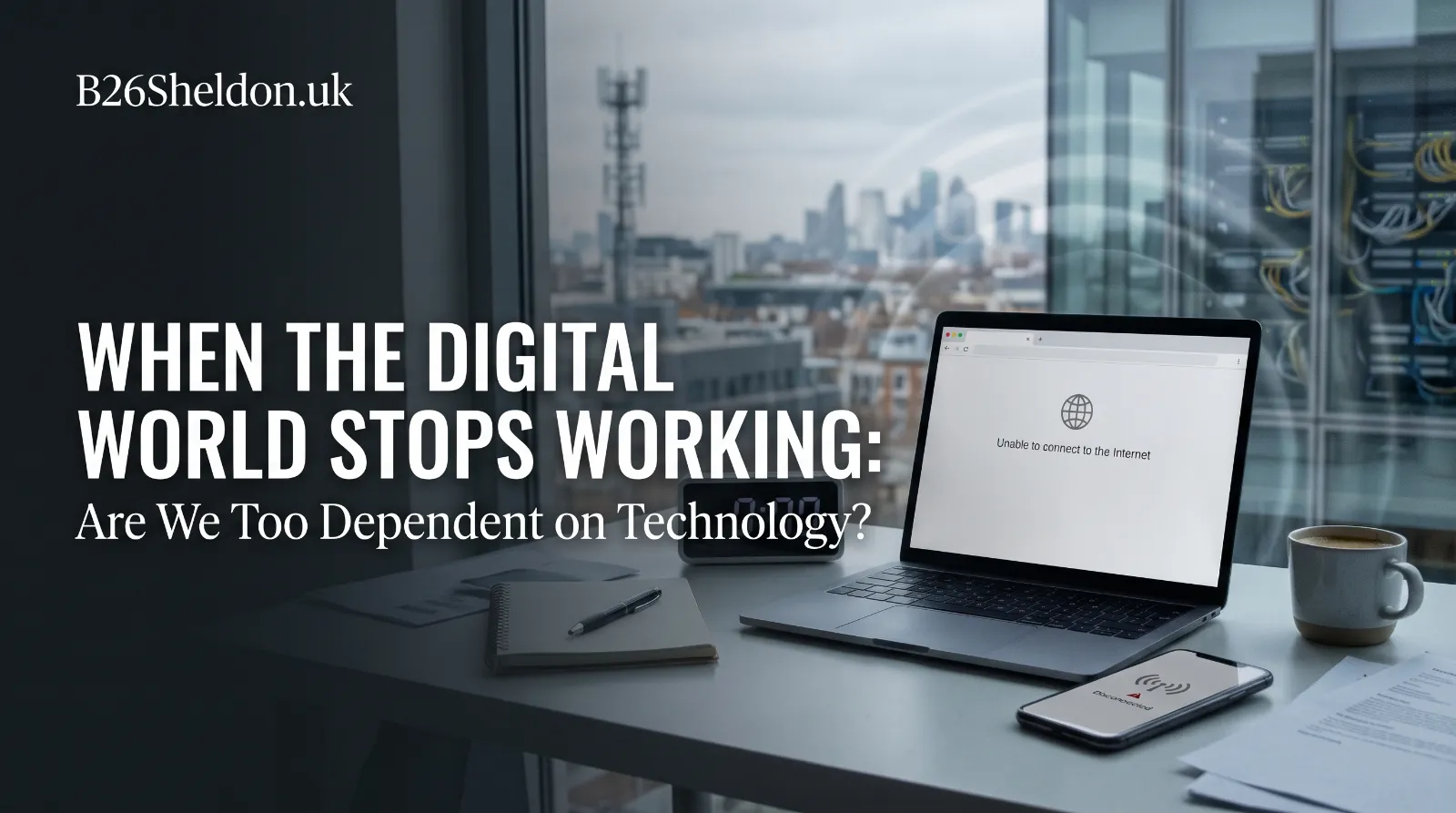
Microsoft's Outlook, Teams and Copilot services suffered a major worldwide outage on Thursday 12 November, with problems continuing into Friday. Microsoft said a network fault caused the disruption and reported no evidence of malicious activity.
For some people, it meant losing access to email, struggling to join meetings and being unable to use everyday office tools. It is a fair prompt to ask how much of ordinary life now depends on services we cannot see, and cannot fix ourselves.
What went wrong at Microsoft
Microsoft said the incident began with a problem during an earlier network capacity upgrade. The issue surfaced after a more recent network change, affecting access to several of its services.
The company described the cause as a technical problem and said it had found no evidence of malicious activity.
That difference matters. A technical fault and a cyber attack are two separate problems. But if your email is unavailable, you can be locked out either way.
The disruption was reported across dozens of countries, with Microsoft working to restore services as the problems continued into Friday.
Cyber attacks are a different risk
Earlier in November, cyber attackers targeted internet-connected refrigeration systems at supermarkets across Europe. Reports said some units were forced into defrost mode, creating problems for businesses relying on them.
The UK was affected too. In a written parliamentary answer on 12 November, the Government said a small number of UK organisations had been caught up in the cyber activity and that the impact remained limited. Reports also identified UK meat suppliers among those affected.
The Government said the National Cyber Security Centre (NCSC) had alerted other organisations that might be exposed.
The NCSC's chief executive also discussed an earlier incident in France, where older equipment connected to the internet was reportedly using default passwords. That is a reminder that cyber security is not just about laptops, phones and office computers. Equipment used in shops, warehouses and other workplaces can also be connected to the internet.
The Microsoft outage and the refrigeration attacks are not linked. They are two different examples of how technology can let us down: one through a technical failure, the other through malicious activity.

A day without it
Picture waking up to find that your email is unavailable, your banking app will not open, a card payment fails and you cannot access a document stored online.
These are hypothetical examples, but they show how quickly an ordinary day could become difficult when several services we rely on are unavailable.
For a business, even a few hours of disruption can mean lost sales, missed appointments and delayed deliveries. For a household, it could mean difficulty accessing money, important information or the people they need to contact.
We have stopped keeping backups of our own lives
Not long ago, people wrote phone numbers in a notebook, kept important papers in a drawer and made plans without relying on a messaging app.
Many of those habits have gradually disappeared.
Photos live online. Documents sit in cloud storage. Banking happens on a phone. None of that is wrong, and it has made everyday life much more convenient.
But if your phone is lost or its battery runs flat, could you recall a family member's number? If the internet goes down, do you have another way to contact people? And if you cannot access your online documents, do you have another copy of the information you need?
These are small questions, but they are worth thinking about.
Going back isn't the answer
Technology has done a great deal for healthcare, education, communication and work. I'm not suggesting that we should give any of that up or return to a time before smartphones and the internet.
The point is to avoid relying on one route for everything. A few simple steps can make a difference:
- Write down key phone numbers and keep them somewhere other than your phone.
- Have a second way to pay, so one app or card failing does not leave you stuck.
- Keep paper or offline copies of essential documents and important information.
- Back up photos and files, and check that you can actually restore them.
- Agree how to reach family if messaging apps or the internet are unavailable.
Businesses need to think beyond having a broadband connection. They need backup systems, alternative ways to communicate and a plan for operating when their usual tools are unavailable.
The NCSC advises organisations to keep secure backups separate from their main systems and regularly test that they can be restored.
Preparing does not mean expecting everything to collapse. It means knowing what to do if one service goes dark.
What do you think?
Nobody can prevent a major technology company from having a bad day, or stop every cyber attack. But a disruption online should not automatically bring our own lives to a halt.
Have we become too dependent on technology, or is this simply the cost of living in a connected world?
Could you manage 24 hours without the internet or your phone?
Sources
- CNN, Microsoft global outage live coverage, 12–13 November 2026.
- TechRadar, Microsoft outage live coverage, 12 November 2026.
- UK Parliament, written question UIN 40973, concerning commercial refrigeration equipment and recent cyber attacks, answered 12 November 2026.
- Computing, Fridge cyberattacks affect UK meat suppliers, November 2026.
- National Cyber Security Centre, Disruptive cyber attacks: preparing technical recovery.
- National Cyber Security Centre, Ransomware-resistant backups.


Loading comments…