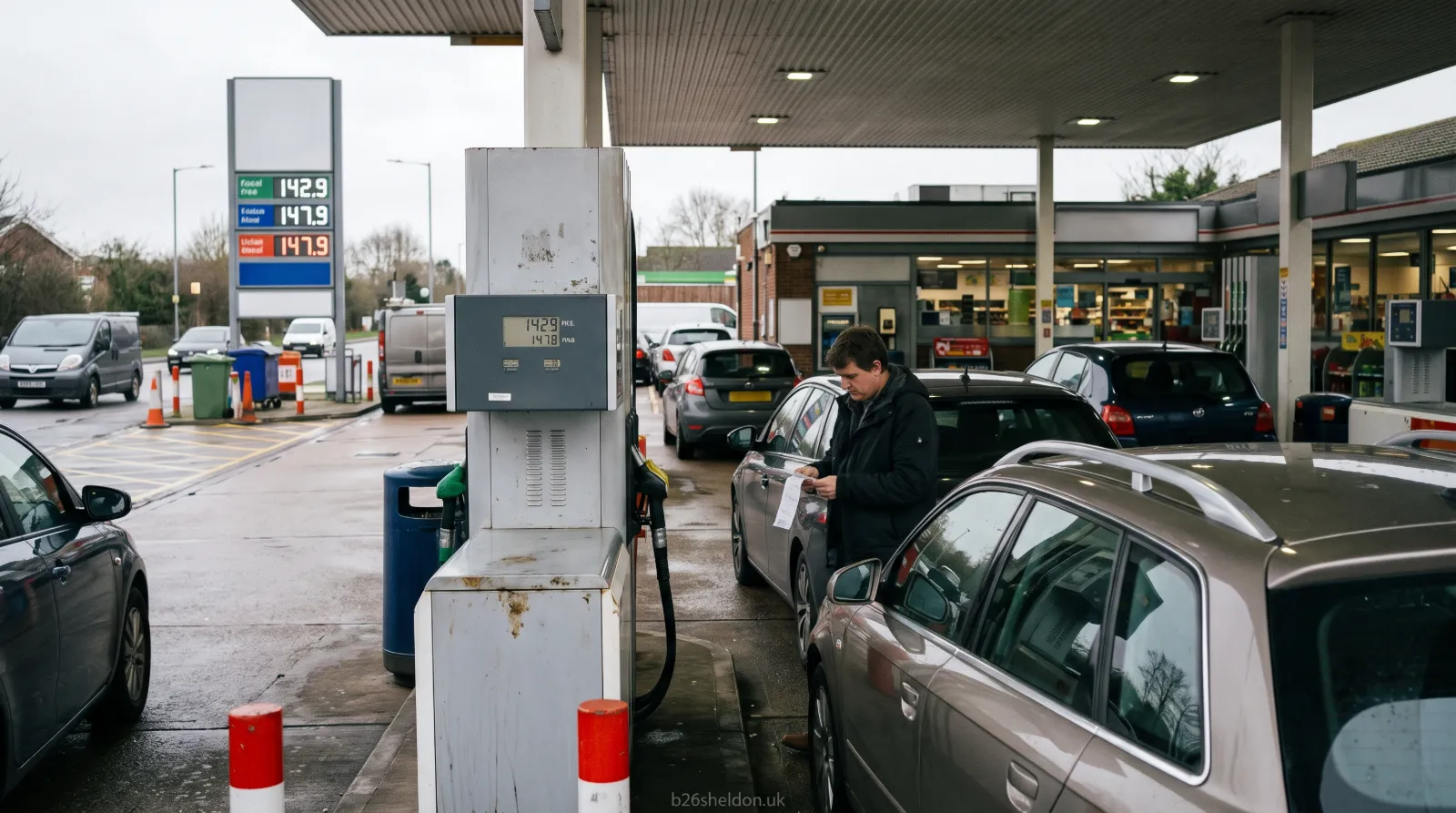
Overcharged at the Pump? How to Report Fuel Price Problems in the UK
With diesel prices reaching £2 a litre in October 2026, motorists across the UK have been paying closer attention to what they are charged at petrol stations.
The latest figures reported on 11 November show that diesel prices remain close to that level, despite some recent reductions in wholesale fuel costs.
For drivers in Sheldon, Yardley and across Birmingham, checking fuel prices before setting off can make a difference. But what happens when the price shown on an app does not match the forecourt, the pump appears to charge more than advertised, or you suspect you have received less fuel than you paid for?
There are different authorities responsible for these problems. Knowing where to report an issue can save time and help regulators identify businesses that are not following the rules.
Can a petrol station charge whatever it wants?
Generally, yes.
UK petrol retailers are free to set their own prices. There is no general legal limit on how much a litre of petrol or diesel can cost.
A station charging 180p per litre when another nearby station charges 165p is not automatically breaking the law.
However, that does not mean retailers can mislead customers, use inaccurate measuring equipment or ignore their legal reporting responsibilities.
The important distinction is between a high price and a potentially unlawful trading practice.
What can Trading Standards investigate?
Local authority Trading Standards teams deal with a range of consumer protection and weights-and-measures issues.
At petrol stations, these can include:
1. Misleading price information
If a station displays one price on its roadside sign but charges a different price at the pump, customers should raise the issue with the station and consider reporting it.
A discrepancy may amount to a misleading commercial practice, depending on the circumstances and how the price was displayed.
However, a difference does not automatically mean the retailer has committed an offence. The circumstances and evidence matter.
2. Inaccurate fuel pumps
Fuel dispensers must meet legal standards for measuring the amount of petrol or diesel supplied.
Trading Standards officers can inspect and test pumps to check their accuracy. If a dispenser is found to be delivering less fuel than its display indicates, enforcement action may follow.
If you suspect a pump is faulty, report it rather than attempting to test or interfere with the equipment yourself.
3. Misleading fuel descriptions
Drivers should be able to identify which fuel grade they are purchasing.
For example, standard E10 petrol and premium E5 petrol are different products. A retailer must not mislead customers about the fuel being supplied.
Fuel Finder: New rules for petrol stations in 2026
One of the biggest changes affecting UK motorists this year is the introduction of the government's Fuel Finder scheme.
Under the Motor Fuel Price (Open Data) Regulations 2025, petrol stations selling fuel to the public must register their forecourts and report their prices.
The price-reporting requirement came into force on 2 February 2026.
Retailers must submit an updated fuel price within 30 minutes of any price change.
The information is made available through Fuel Finder so that authorised organisations and third-party apps and websites can provide motorists with fuel-price comparisons.
This means drivers can make more informed decisions about where to fill up.
What happens if a station does not update its price?
Imagine checking a fuel comparison app before leaving home.
The app shows diesel at 174.9p per litre. You drive to the station, only to discover that the price is now 181.9p.
There could be several explanations. The app may not have refreshed its information, or the retailer may have failed to submit the required price update.
If the app or website uses Fuel Finder information, you can report the discrepancy through the government's official reporting service.
The Competition and Markets Authority (CMA) has powers to investigate potential non-compliance with the reporting rules.
On 2 April 2026, the CMA issued an open letter to fuel retailers reminding them of their responsibilities. It also announced that it would prioritise enforcement action against potential Fuel Finder non-compliance from 1 May 2026.
Importantly, an outdated price on an app does not automatically prove that the petrol station has broken the law. The timing of the price change and the information supplied by the retailer need to be considered.
Which authority should you contact?
The correct reporting route depends on what has happened.
Problem
Where to report it
Pump price differs from the advertised price
Citizens Advice Consumer Service / Trading Standards
Suspected faulty or inaccurate fuel pump
Citizens Advice Consumer Service / Trading Standards
Incorrect fuel price on an app using Fuel Finder data
GOV.UK Fuel Finder reporting service
Incorrect forecourt information or fuel grade
GOV.UK Fuel Finder reporting service
Suspected anti-competitive behaviour in the fuel market
Competition and Markets Authority
1. Reporting to Trading Standards
In England and Wales, consumers can contact the Citizens Advice Consumer Service.
Telephone: 0808 223 1133
Opening hours are Monday to Friday, 9am to 5pm.
You can also use the Citizens Advice website to report a consumer problem.
Your information can be passed to the relevant local Trading Standards team. Officers decide whether further investigation is appropriate.
Trading Standards does not normally negotiate individual refunds on behalf of customers.
2. Reporting an incorrect Fuel Finder price
The government has a dedicated service for motorists to report inaccurate fuel prices and forecourt information.
You can use it to report:
- A price shown on an app that differs from the actual forecourt price.
- Incorrect fuel grades or prices.
- Incorrect forecourt details.
- Other inaccurate information, including opening times and facilities.
Official reporting service:
You will need the station's name and address or postcode, the date and time you noticed the problem, and details of the discrepancy.
Photographs and screenshots are optional but useful.
Reports can be submitted anonymously. The information may be shared with the forecourt operator or local Trading Standards, and can help the CMA identify possible breaches.
3. Reporting concerns to the CMA
The CMA monitors competition in the UK road fuel market.
Its work includes examining whether competition is working properly and whether motorists are getting a fair deal.
The CMA has previously raised concerns about weakened competition in the petrol and diesel retail market.
If you have evidence suggesting anti-competitive behaviour, you can contact its road fuel monitoring team.
Email: [email protected]
However, a petrol station charging more than its competitors is not, by itself, evidence of anti-competitive behaviour.
The CMA does not set petrol prices or approve individual forecourt prices.
How to make a useful complaint
If you notice something wrong at a petrol station, a little evidence can make your report more useful.
Here are five things to do.
1. Take photographs
Photograph the roadside price board, the pump display and, where possible, the fuel grade selected.
If the problem involves a comparison app, take a screenshot showing the advertised price and the time.
2. Keep your receipt
Your receipt provides useful evidence of the transaction, including the fuel grade, quantity, price per litre and total amount paid.
3. Speak to the station manager
Explain what you have noticed and ask the manager to clarify the difference.
If the issue concerns a displayed price, ask whether the station will correct the charge or refund any difference.
Do not assume the retailer is legally required to honour every incorrect sign price. The circumstances will matter.
4. Record the details
Make a note of:
- Station name and full address.
- Date and approximate time.
- Fuel grade.
- Advertised price and actual pump price.
- What the manager or cashier told you.
5. Use the correct reporting service
Contact Citizens Advice for a potential consumer protection or measuring issue. Use the government's Fuel Finder reporting service for inaccurate forecourt data.
If you believe there is evidence of anti-competitive conduct, you can also provide information to the CMA.
What does this mean for motorists in Sheldon and Birmingham?
Drivers in Sheldon and Yardley have several petrol stations within a relatively short driving distance, and fuel prices can vary between forecourts.
Checking prices before travelling is useful, particularly when diesel and petrol prices are changing quickly.
Fuel Finder should make it easier to compare prices, but motorists should still check the price displayed at the station before filling up.
If something does not look right, keep the receipt and take a photograph. Reporting an accurate discrepancy can help enforcement authorities identify repeated problems.
The important thing is to report the right issue to the right organisation. A high price is one thing; misleading information, inaccurate fuel measurement and failure to follow statutory reporting requirements are different matters.
Useful official links
- Report an error in fuel prices – GOV.UK
- Fuel Finder scheme – GOV.UK
- Report a business to Trading Standards – Citizens Advice
- Consumer rights and advice – GOV.UK
- CMA road fuel monitoring guidance – GOV.UK
B26 Sheldon is an independent news blog. This article provides general consumer information and is not legal advice.

Loading comments…